




Skip Navigation

Pediatric Education for Prehospital Professionals™ (PEPP™)

Confidence in Caring for Infants, Children, and Youth

Pediatric Education for Prehospital Professionals™ (PEPP™) 5th Edition is a comprehensive training solution from the American Academy of Pediatrics designed to help EMS clinicians confidently care for infants, children, and youth in emergency situations.


EMS provider kneeling at eye level to calmly reassure a young girl during a pediatric emergency call.

American Academy of Pediatrics dedicated to the health of all children PEPP

Interested in purchasing for your organization?

From Knowledge to Confidence in Pediatric Emergency Care

Developed in collaboration with pediatric specialists and experienced EMS professionals, the PEPP™ Provider course reflects the realities of prehospital care. It delivers a comprehensive approach that goes beyond resuscitation, covering the full spectrum of emergencies involving infants, children, and youth.

Through True Adaptive™ eLearning, engaging visuals, and hands-on skills sessions, learners build practical experience in assessment, decision-making, and intervention. The course prepares EMS clinicians to act with confidence when it matters most.

EMS providers performing bag-valve-mask ventilation on an infant patient simulator

Specialized Prehospital eLearning Modules

The curriculum covers assessment, trauma, medical and behavioral emergencies, newborn stabilization, and care for children and youth with special healthcare needs.

Specialized Prehospital eLearning Modules

The curriculum covers assessment, trauma, medical and behavioral emergencies, newborn stabilization, and care for children and youth with special healthcare needs.

  1. Pediatric Assessment
  2. Respiratory Emergencies
  3. Medical Emergencies A
  4. Medical Emergencies B
  5. Trauma
  6. Children In Disasters
  7. Emergency Birth and Newborn Stabilization
  8. Children and Youth with Special Healthcare Needs – Family Centered Care
  1. Children and Youth with Special Healthcare Needs – Technology Dependent
  2. Child Maltreatment
  3. Shock
  4. Behavioral Emergencies
  5. Toxic Emergencies
  6. Pediatric Cardiac Arrest Resuscitation
  7. Pediatric Dysrhythmias

Instructor-Led Event (ILE)

  • In-person, hands-on skills session
  • Scenario-based practice reflecting real EMS calls
  • Skills validation and team-based learning
  • Focus on building confidence in execution
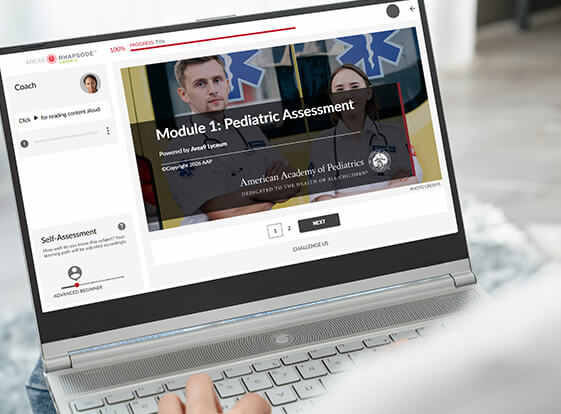
Laptop displaying PEPP Module 1: Pediatric Assessment eLearning course interface

Training for Both ALS and BLS Providers

Designed for EMS clinicians, the PEPP course emphasizes real-world application and confidence in the field, with ALS and BLS curriculums available to match provider level and scope of practice.

Completion and Continuing Education

Upon completion, learners are eligible for CE credits and will earn  a PEPP (ALS or BLS) Provider eCard, valid for two years.

BLS PEPP Providers Part 1 CE Credits

Emergency Medical Service Provider

This continuing education activity is approved by the American Academy of Pediatrics, an organization accredited by the Commission on Accreditation of Pre-Hospital Continuing Education (CAPCE), provider number AAOP3807, activity number 26-AAOP-F3-3001.

This CE activity is accredited by the Commission on Accreditation for Pre-Hospital Continuing Education (CAPCE) for 6.00 Basic CEHs. CAPCE represents that this program has met standards for accreditation and does not endorse the opinions or content presented. For more information, or to register a concern go to: https://www.capce.org/CertificateTrouble/Index.

BLS PEPP Providers Part 2 CE Credits

Emergency Medical Service Provider

This continuing education activity is approved by the American Academy of Pediatrics, an organization accredited by the Commission on Accreditation of Pre-Hospital Continuing Education (CAPCE), provider number AAOP3807, activity number 26-AAOP-F2-3002.

This CE activity is accredited by the Commission on Accreditation for Pre-Hospital Continuing Education (CAPCE) for 4.75 Basic CEHs. CAPCE represents that this program has met standards for accreditation and does not endorse the opinions or content presented. For more information, or to register a concern go to: https://www.capce.org/CertificateTrouble/Index.

ALS PEPP Providers Part 1 CE Credits

Registered Nurse Provider

Provider approved by the California Board of Registered Nursing, Provider Number 18014, for 6.00 contact hours.

Emergency Medical Service Provider

This continuing education activity is approved by the American Academy of Pediatrics, an organization accredited by the Commission on Accreditation of Pre-Hospital Continuing Education (CAPCE), provider number AAOP3807, activity number 26-AAOP-F3-3003.

This CE activity is accredited by the Commission on Accreditation for Pre-Hospital Continuing Education (CAPCE) for 6.00 Advanced CEHs. CAPCE represents that this program has met standards for accreditation and does not endorse the opinions or content presented. For more information, or to register a concern go to: https://www.capce.org/CertificateTrouble/Index.

ALS PEPP Providers Part 2 CE Credits

Emergency Medical Service Provider

This continuing education activity is approved by the American Academy of Pediatrics, an organization accredited by the Commission on Accreditation of Pre-Hospital Continuing Education (CAPCE), provider number AAOP3807, activity number 26-AAOP-F2-3004.

This CE activity is accredited by the Commission on Accreditation for Pre-Hospital Continuing Education (CAPCE) for 7.00 Advanced CEHs. CAPCE represents that this program has met standards for accreditation and does not endorse the opinions or content presented. For more information, or to register a concern go to: https://www.capce.org/CertificateTrouble/Index.

FAQs

Nearly

55%

More out-of-hospital births have occurred over the past decade. As the number of out-of-hospital births continue to rise, the need for targeted neonatal education for EMS Clinicians has never been greater.2

References

  1. Centers for Disease Control and Prevention (CDC), National Center for Health Statistics. Births: final data for 2022. Natl Vital Stat Rep. 2024;73(2):Tables I‑4–I‑5. Available from: https://www.cdc.gov/nchs/data/nvsr/nvsr73/nvsr73-02-tables.pdf
  2. Centers for Disease Control and Prevention (CDC), National Center for Health Statistics. Births: final data for 2022. Natl Vital Stat Rep. 2024;73(2):Tables I‑4–I‑5. Available from: https://www.cdc.gov/nchs/data/nvsr/nvsr73/nvsr73-02-tables.pdf

References

  1. https://www.aap.org/en/patient-care/congenital-heart-defects/congenital-heart-defect-fact-sheets/
  2. Oster M, Lee K, Honein M, Colarusso T, Shin M, Correa A. Temporal trends in survival for infants with critical congenital heart defects. Pediatrics. 2013;131(5):e1502-8.