
Ireland: How a Small Nation Became a Global Leader in Bystander CPR
Ireland: How a Small Nation Became a Global Leader in Bystander CPR
When sudden cardiac arrest strikes, it rarely gives warning. One moment a person is talking, laughing, or making dinner and the next, their life depends entirely on the people standing beside them. In those first few minutes, before an ambulance can arrive, survival hinges on one thing: whether someone nearby knows how to act.
Around the world, out‑of‑hospital cardiac arrest (OHCA) remains one of the leading causes of death. According to global registry data, between 30 and 100 people per 100,000 experience EMS‑treated cardiac arrest each year, and most of these events happen at home, not in public spaces. That means the first responder is almost always a loved one, not a clinician.
And this is where Ireland’s story becomes remarkable.
A Global Picture and Ireland’s Standout Success
The latest International Liaison Committee on Resuscitation (ILCOR) report, analyzing OHCA data from 18 registries between 2018 and 2021, shows enormous variation in bystander CPR rates worldwide. In 2021, some regions reported rates as low as 9.6%, while others reached 83.8%, with a global median of 61.7%.
Ireland sits near the very top of that range. For several years running, Ireland consistently reports some of the highest bystander CPR rates in the world – exceeding 70%.1
This didn’t happen by chance. It happened because Ireland made CPR a national priority.
How Ireland Built a Culture of Action
Ireland’s success stems from a decade‑long commitment to CPR education, dispatcher‑assisted CPR, community engagement, and public awareness. The Irish Heart Foundation, Ireland’s national heart and stroke charity, has been central to this effort, championing training programs and advocating for widespread AED access.
One example is the Hands for Life program, a free community CPR training initiative in Ireland, developed by the Irish Heart Foundation in 2019, with support from Abbott and ESB Networks. Its main objective is to train 100,000 people across Ireland in crucial, life-saving CPR skills and AED use to improve survival rates for cardiac arrests.
But the real engine behind Ireland’s progress is collaboration. In a Q&A, Brigid Sinnott, Resuscitation Manager at the Irish Heart Foundation, explains that no single initiative can take credit. She said, “I think a combination of all mentioned has contributed to the bystander rates. I don’t think we can say that just one thing that we implemented did this.”
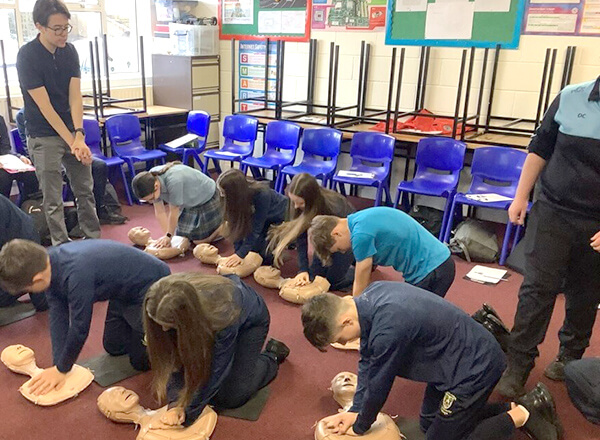
Ireland’s OHCA register, established in 2012, allows the country to track progress and identify areas for improvement each year. National campaigns have focused on “taking the fear out of doing CPR,” according to Sinnott. The CPR 4 Schools program, a free program available for all post primary schools in Ireland designed to take up only 60 minutes to teach, is now in its 11th year and has already produced real‑world lifesavers among teachers and students.
The Power of Community First Responders
One of Ireland’s most powerful strategies has been the development of Community First Responder (CFR) groups. These volunteer teams are alerted by the National Ambulance Service and respond to emergencies in their own neighborhoods.
“These groups respond to chest pains, strokes, cardiac arrest and choking…made up of members of the general public. They train regularly to keep their skills sharp but also train members of their own community in CPR,” Sinnott said.
This grassroots model strengthens the first three links in the OCHA chain of survival—recognition, CPR, and defibrillation—long before professional help arrives.
The Untapped Opportunity of AED Use
Even in high-performing countries like Ireland, AED use remains a global challenge. While CPR rates tell an encouraging story, the ILCOR data also highlights a global opportunity. Bystander use of automated external defibrillators (AEDs) remains low, ranging from under 1% to about 28% worldwide in 2021. 2
Ireland’s strategy emphasizes accessibility and training.
Sinnott advises communities to ensure AEDs are available to everyone and paired with CPR education.
“Make sure the AED is accessible to all and ensure that they have people trained in CPR,” Sinnott said.
Preparedness in a Pandemic
The COVID‑19 pandemic strained emergency systems worldwide, and many regions saw declines in survival and neurological outcomes. Yet communities with strong bystander CPR participation—like Ireland—continued to outperform others. Preparedness works, even under pressure.
What Other Countries Can Learn from Ireland
Ireland’s small size may help, but its real advantage is unity—ambulance services, schools, voluntary groups, and national organizations all working toward the same goal.
“All stakeholders need to be engaged and have a common vision,” Sinnott said. “Developing an OHCA strategy made us focus on where we needed to improve.”
Sinnott leaves readers with a simple, powerful reminder: “We all have the power to save a life. Take a CPR course…remember you can do no harm by starting CPR.”
More than 75% of cardiac arrests happen at home. The life you save is likely to be someone you love.
Ireland’s story shows what’s possible when a nation embraces CPR as a shared responsibility. It’s not just a medical intervention, it’s a community skill, a cultural norm, and a collective promise to act when it matters most.
1, 2 Greif R, Lauridsen KG, Djärv T, et al. European Resuscitation Council Guidelines 2025: Education for Resuscitation. Resuscitation. 2025;215(Suppl 1):110739. https://doi.org/10.1016/j.resuscitation.2025.110739. (S0300‑9572(25)00364‑8)
We're committed to sharing the latest information on high-quality digital resuscitation education and related topics from industry leaders.

We're committed to sharing the latest information on high-quality digital resuscitation education and related topics from industry leaders.