




Advancing CPR Training with the Resuscitation Quality Improvement® (RQI®) Program at Columbus Division of Fire
Advancing CPR Training with the Resuscitation Quality Improvement® (RQI®) Program at Columbus Division of Fire
The Challenge
Tackling a Training “Time Vampire”
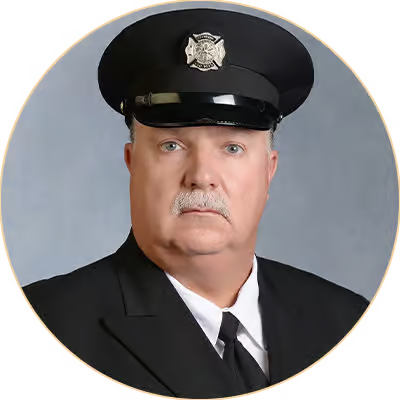
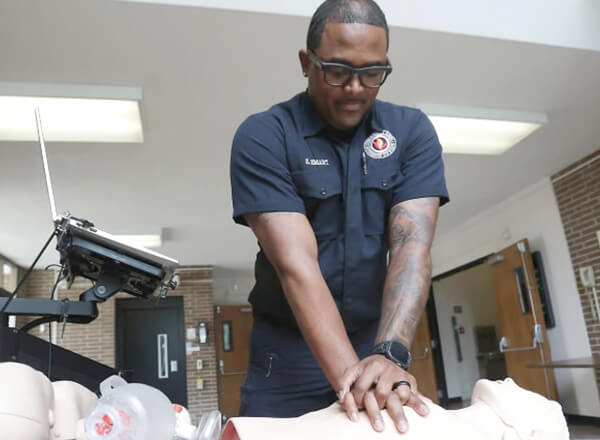
Firefighter Robert Kelley, EMS Training Specialist at the Columbus Division of Fire (CFD) in Ohio, provides high-quality training to all the firefighters in the division.
 CFD has over 1,600 firefighters – including 800 trained at the paramedic level. The department also handles bomb response, K-9, hazmat, and heavy rescue training for central Ohio.
“There’s a lot of training that needs to happen to maintain those certifications,” explains Firefighter Kelley. “So what we were looking [for] was to get some of our training dates cleared off the calendar.”
“BLS, ACLS, and PALS…for that amount of people every two years, was really a ‘time vampire’ on our schedules,” he adds. “So we were looking [for] a way to free that up.”
Plus, each training session created additional costs by requiring backfilled positions through overtime. “We have to be good stewards of taxpayer dollars,” he says.
“We don’t have the luxury of putting a sign in the window saying we’ll be back in eight hours,” he points out. “When people call 911, they expect people to be there. So we were backfilling over half of the members that we were bringing down for class.”
The Solution
Increased Efficiency Through Low-Dose, High-Frequency Training
To address the need to increase efficiency in training, Firefighter Kelley and his team decided to try the RQI program: an innovative resuscitation training program developed by the American Heart Association in collaboration with Laerdal Medical.
RQI’s features include:
- True Adaptive™ eLearning: an advanced adaptive algorithm that facilitates the most efficient path to mastery, uniquely addressing the needs of the individual learning
- Low-dose, high-frequency training: Learner conducts deliberate practice independently on a quarterly basis – improving and retaining skills mastery.
- Perpetual AHA eCredentials: RQI eCredential is the American Heart Association’s new gold standard.
With minimal reliance on instructor presence, RQI would allow firefighters the flexibility to seamlessly integrate training into their schedules without disrupting their duties.
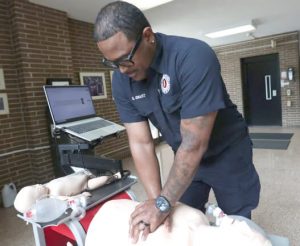
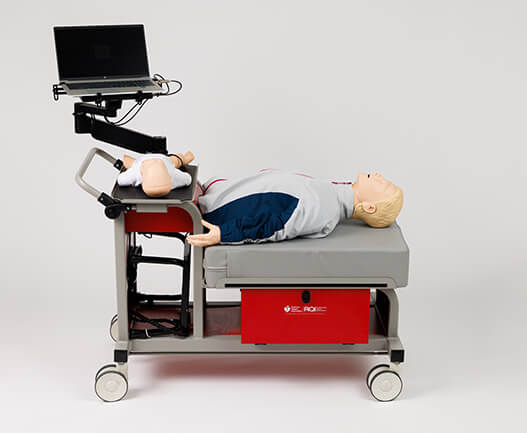
Firefighter Kelley started with eight RQI simulation stations. Each station contained adult and infant manikins, plus a laptop. They kept one at their training academy, and the rest in each of their seven battalions. Each battalion station was rotated every two weeks so that every station would have a chance to use it.
“The simulation stations are incredibly durable and easy to move,” he says. “We have a cargo van. We put a lift gate on the back. We simply unplug it from the one station, roll it out to the van, lift it up in there, take it to the next station, plug it in, and they’re ready to go.”
The Results
Data-Backed Performance Gains
 Implementing the RQI program at CFD was a resounding success. RQI not only enhanced training efficiency but also led to measurable improvements in performance.
The RQI platform provides comprehensive performance data for each learner. “We looked at the data – because data is something concrete, tangible, and something that we can show everyone,” he says. “We looked at the analytics that we got from the system, along with the CARES registry information [to help us see where we stand] not only in central Ohio, but across the nation.”
“What we found was that we were doing good adult CPR. Our baseline entry into RQI [was] 90% for ventilations and compressions. We have since moved those up to 98% and 99%, respectively.”
Infant CPR, however, was a different story. The performance data from RQI helped them recognize that their infant CPR performance wasn’t where they wanted it to be.
“We took the data and we did something about it; we put it into action. And with training with the RQI program, I am very happy to say we’re at 97% now with those [infant] compressions. And we attribute it primarily to the RQI – to that repetition, every quarter doing infant CPR.”
“The good thing about cardiac arrest in infants is it doesn’t happen that often,” he says. “The bad thing is it doesn’t happen that often. So people don’t get comfortable dealing with infants. RQI is a great way for our folks to bridge that gap.”
Upon renewing their contract, he and his team opted for an additional eight RQI carts, allowing them to have one stationary cart in each battalion. Having the additional carts helped even more with maintaining compliance.
Increased Survivability Through Enhanced Training
“RQI has improved our outcomes in cardiac arrest,” he shares. “We look at the whole picture – it’s not just one aspect of cardiac arrest resuscitation. RQI is definitely key because it took away our need to focus on and train actively on compressions and ventilations.
We could spend more training time working with defibrillation monitors – getting our crews more comfortable with that monitor, analyzing that cardiac rhythm within five seconds, and delivering that shock – because RQI was taking care of the time that we would’ve spent in the classroom with the fundamentals. It definitely contributed to the overall success and our increased survivability rate in central Ohio.”
“RQI has allowed us to deliver high-quality CPR training in a way that’s flexible, cost-effective, and repeatable. Through our engagement with this innovative learning solution, we provide our members with state-of-the-art knowledge and skill reinforcement. As a result, we’ve seen significant improvements in our ability to perform and maintain high-quality CPR for both adult and pediatric patients.”