



Skip Navigation

Leading Science in Resuscitation Training

The digital resuscitation portfolio of programs incorporates the latest American Heart Association science and Laerdal Medical technology for a learning experience that aims to achieve mastery of resuscitation skills.

Learners reach this level of mastery with deliberate practice and the use of the RQI Simulation Station in a low-dose, high-frequency model.

RQI BLS Provider - True Start

Why it Matters?

The American Heart Association® and Laerdal Medical have spent more than a decade developing evidence-based solutions to overcome limitations in non-standardized resuscitation training for healthcare professions.

In 2018, the AHA recognized the body of research highlighting educational strategies to improve outcomes from cardiac arrest, including the benefits of low-dose, high-frequency training, debriefing, deliberate practice, contextual learning, feedback, assessment, and mastery learning.1

The resuscitation quality improvement model incorporates these recommendations to verify competence in high-quality resuscitation. Through leveraging science to maximize educational efficiency, the RQI program quickly enhances CPR performance through one training session and prevents skill decay through quarterly practice.2-10
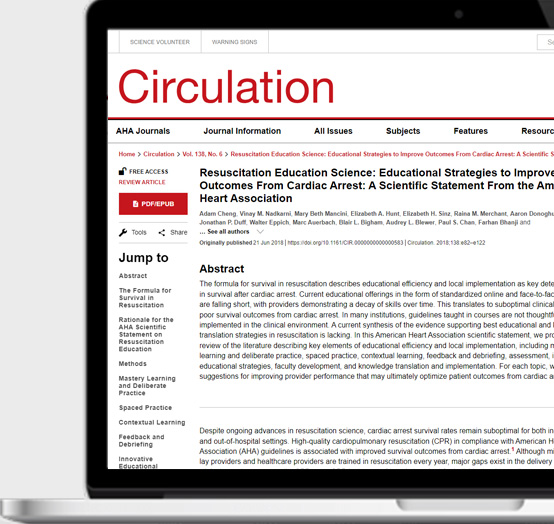
Circulation, AHA Journals
References
  1. Cheng A, Nadkarni VM, Mancini MB, et al. Resuscitation education science: educational strategies to improve outcomes from cardiac arrest: a scientific statement from the American Heart Association. Circulation. 2018;138(6):e82-e122. doi:10.1161/CIR.0000000000000583
  2. Kardong-Edgren S, Oermann MH, Jastrzembski TS, et al. Baseline cardiopulmonary resuscitation skill performance of nursing students is improved after one Resuscitation Quality Improvement skill refresher. J Nurses Prof Dev. 2020;36(2):57-62. doi:10.1097/NND.0000000000000614
  3. Oermann MH, VanRiel YM, Stieve DE, et al. Developing competency of nursing students in cardiopulmonary resuscitation using Resuscitation Quality Improvement technology. Int J Nurs Educ Scholarsh. 2024;21(1). doi:10.1515/ijnes-2023-0122
  4. Panchal AR, Norton G, Gibbons E, Buehler J, Kurz MC. Low dose- high frequency, case based psychomotor CPR training improves compression fraction for patients with in-hospital cardiac arrest. Resuscitation. 2020;146:26-31. doi:10.1016/j.resuscitation.2019.10.034
  5. Sabogal-Rodriguez CC. Effects of low-dose, high-frequency cardiopulmonary resuscitation education on nurses’ competency and confidence. Nursing & Health Sciences Research Journal. 2024;7(1):22-49. doi:10.55481/2578-3750.1188
  6. Klacman A, Barnes D, Wang J. The effects of a novel quarterly cardiopulmonary resuscitation training program on hospital basic life support providers’ cardiopulmonary resuscitation skill performance. J Nurses Prof Dev. 2021;37(3):131-137. doi:10.1097/NND.0000000000000727
  7. Oermann MH, VanRiel YM, Wagner RW. Maintenance of CPR skills among nursing students trained using Resuscitation Quality Improvement program. Resusc Plus. 2024;20:100782. doi:10.1016/j.resplu.2024.100782
  8. Mota S. Resuscitation Quality Improvement: improving clinicians’ performance. AACN Adv Crit Care. 2023;34(3):182-188. doi:10.4037/aacnacc2023833
  9. Pighills AC, Wayne R, Taylor S, et al. RCT comparing the clinical effectiveness of conventional instructor-facilitated cardiac compression training to technology enhanced training using high-fidelity mannequins – A pilot study. Journal of Nursing Education and Practice. 2021;11(8):69. doi:10.5430/jnep.v11n8p69
  10. Oermann MH, Krusmark MA, Kardong-Edgren S, Jastrzembski TS, Gluck KA. Personalized training schedules for retention and sustainment of cardiopulmonary resuscitation skills. Simul Healthc. 2022;17(1):e59-e67. doi:10.1097/SIH.0000000000000559
  • The current schedule of 1 to 2 days of resuscitation training every couple of years is effective for short-term learning. However, learners often do not retain these skills in the long term. Shorter learning sessions every few months may improve learning outcomes.

Source: Cheng, A et al. AHA Circulation. 2018

Designing for Quality Improvement​​​​​​​

Educational efficiency is a contributing factor to increased survival outcomes. It forms the cornerstone of the RQI Program design and is a critical component of achieving our mission of saving 150,000 more lives annually by 2025.

RQI applies educational efficiency via design elements based on the AHA 2018 Education Statement and AHA’s 2025 Education Guidelines. This evidence-based approach to educational design allows programs to be developed and evaluated based on research for maximum impact.

At RQI Partners, we apply educational efficiency elements to the entire portfolio to achieve verified competence for all learners. Read more at LearningRQI in the evidence library.

Effects of Low-Dose, High-Frequency Cardiopulmonary Resuscitation Education on Nurses’ Competency and Confidence (2024)
  • Nurses’ CPR performance, competency scores, and confidence scores significantly improved with the RQI program and these improvements were maintained over time.
  • The number of attempts needed to pass their CPR skills tests decreased the longer the learners participated in the RQI program.

Read More about Effects of Low-Dose, High-Frequency Cardiopulmonary Resuscitation Education on Nurses’ Competency and Confidence (2024)

Developing competency of nursing students in cardiopulmonary resuscitation using Resuscitation Quality Improvement technology (2024)
  • Nurses’ CPR skills improved with one session at the RQI Simulation Station. Adult compressions improved by 40%, infant compressions improved by 107%, adult ventilation improved by 51%, and infant ventilation improved by 68%.
  • The percentage of nurses able to perform compressions and ventilation and pass on their first attempt increased the longer they were in the program.

Read More about Developing competency of nursing students in cardiopulmonary resuscitation using Resuscitation Quality Improvement technology (2024)

Maintenance of CPR skills among nursing students trained using Resuscitation Quality Improvement program (2024)
  • When starting the RQI program only 71% of learners were able to pass their CPR skills performance test on their first attempt. With quarterly practice, 82% of learners could pass on their first attempt after six months.
  • CPR training every three months at the RQI Simulation Station enabled learners to maintain and improve their compression and ventilation skills over time.

Read More about Maintenance of CPR skills among nursing students trained using Resuscitation Quality Improvement program (2024)

Longitudinal effect of high frequency training on CPR performance during simulated and actual pediatric cardiac arrest
  • Performance of infant compressions at the simulation station increased from 91.5% in Q1 to 95% in Q5 and infant ventilations from 82.9% in Q1 to 95.5% in Q5
  • Performance of adult/child compressions at the simulation station increased from 84.3% in Q1 to 96.2% in Q5, and adult/child ventilations from 79.8% in Q1 to 95.3% in Q5

Read More about Longitudinal effect of high frequency training on CPR performance during simulated and actual pediatric cardiac arrest

Personalized Training Schedules for Retention and Sustainment of Cardiopulmonary Resuscitation Skills
  • Nursing students who refreshed with 3-month or personalized prescribed intervals had overall higher compression scores compared with those who refreshed at 6-month intervals.

Read More about Personalized Training Schedules for Retention and Sustainment of Cardiopulmonary Resuscitation Skills

Implementation of a Low-Dose, High-Frequency Cardiac Resuscitation Quality Improvement Program in a Community Hospital
  • Over half of participants (67.4%) agreed or strongly agreed that RQI was their preferred method of BLS training versus the traditional 2-year model.
  • 81.8% of participants provided feedback on what they like about the RQI program, including ands-on practice, real-time feedback, repetition and self-directed learning.

Read More about Implementation of a Low-Dose, High-Frequency Cardiac Resuscitation Quality Improvement Program in a Community Hospital

Initial implementation of the resuscitation quality improvement program in emergency department of a teaching hospital in China
  • Post the RQI training, both novice and experienced provider groups achieved qualified CPR performance (score of 75% or more) for compressions and ventilation, per American Heart Association guidelines.

Read More about Initial implementation of the resuscitation quality improvement program in emergency department of a teaching hospital in China

Evidence Library on LearningRQI

LearningRQI presents a collection of research and information that demonstrates the science behind the design of the RQI training model and the impact of the program. The site includes brief article summaries and information on the design elements of resuscitation quality improvement education.
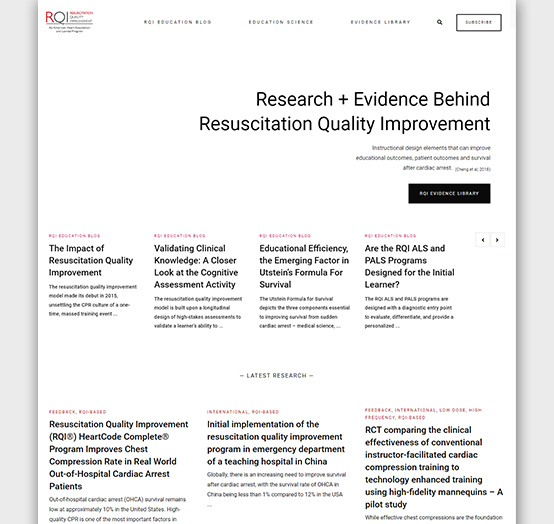
Learning RQI Website
American Heart Association, 2025 CPR & ECC Guidelines, Neonatal Resuscitation Program, 9th Edition

2025 Guidelines

The American Heart Association® (AHA) released the official 2025 AHA Guidelines for CPR & ECC on Wednesday, October 22, 2025. In collaboration with the American Academy of Pediatrics (AAP), the AHA jointly develops pediatric and neonatal resuscitation guidelines, which also released on October 22, 2025. These guidelines reflect the latest global science related to medical and education recommendations for resuscitation.

The AHA Guidelines are considered the gold standard of clinical recommendations in the practice of resuscitation science in North America and around the world.

RQI Analytics

As an additional method of evidence-based practice, RQI Analytics is included in the RQI Portfolio, providing organizations access to their learner performance data with actionable insights. The easy-to-use data visualization dashboard allows administrators to track and identify areas of improvement for provider high-quality skills performance.

RQI Analytics

Studies Show the Impact of Resuscitation Quality Improvement

Lorem ipsum dolor sit amet, consectetur adipiscing elit. Maecenas quis eros sed risus sollicitudin fringilla dictum in metus. Sed ultrices mauris a facilisis varius.

Proof point box

  • Lorem ipsum dolor sit amet, consectetur adipiscing elit,
  • Sed do eiusmod tempor incididunt ut labore et dolore magna aliqua.
  • Ut enim ad minim veniam, quis nostrud exercitation ullamco laboris nisi ut aliquip ex ea commodo consequat.

Case Study Proof Point

  • Lorem ipsum dolor sit amet, consectetur adipiscing elit,
  • Sed do eiusmod tempor incididunt ut labore et dolore magna aliqua.
  • Ut enim ad minim veniam, quis nostrud exercitation ullamco laboris nisi ut aliquip ex ea commodo consequat.
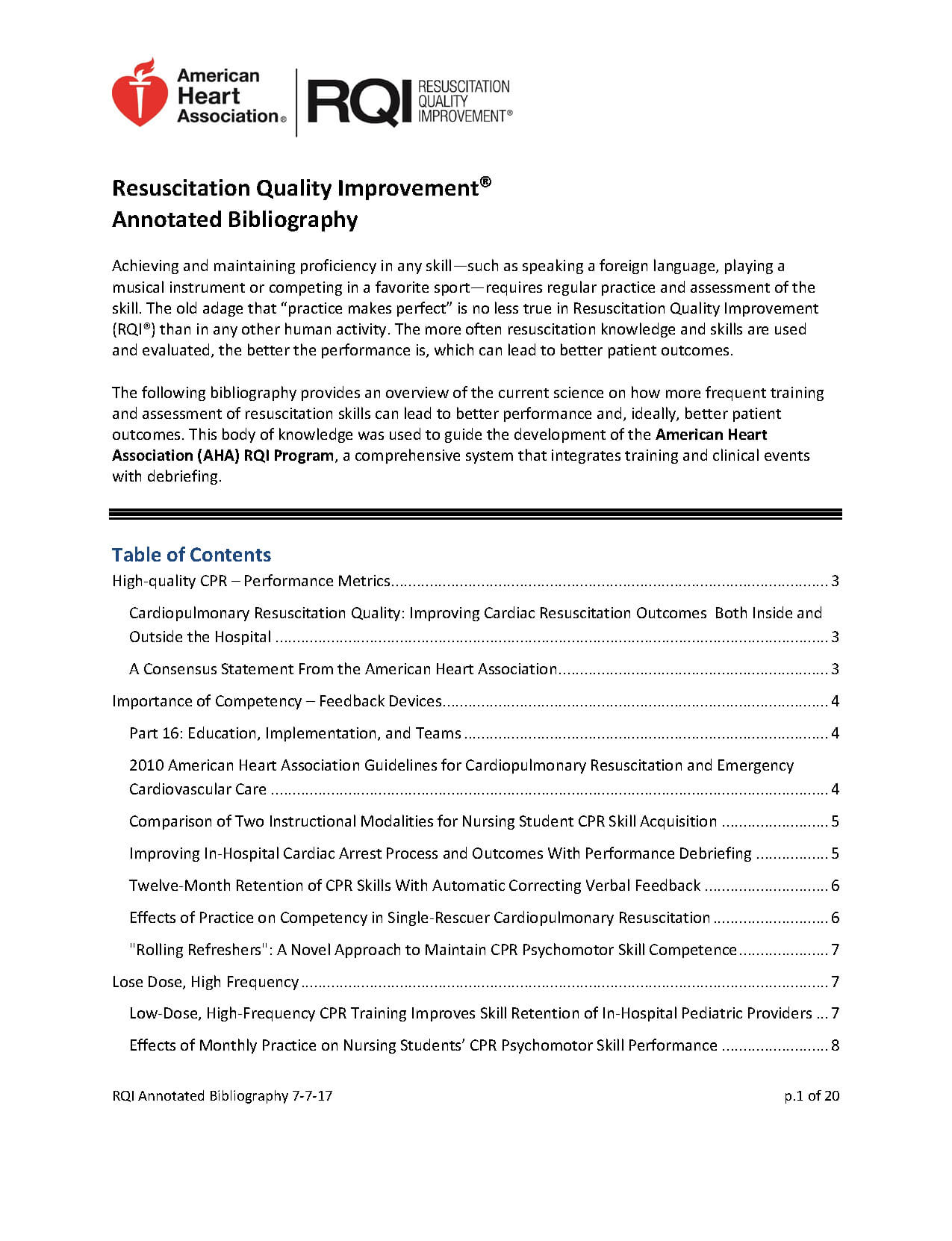
RQI Annotated Bibliography

Resuscitation Quality Improvement® Annotated Bibliography